How to tell when AI is wrong (because sometimes it is)
AI answers with total confidence even when it's mistaken. Here's why that happens and the simple habits that protect you.
Here is the most important sentence on this entire website:
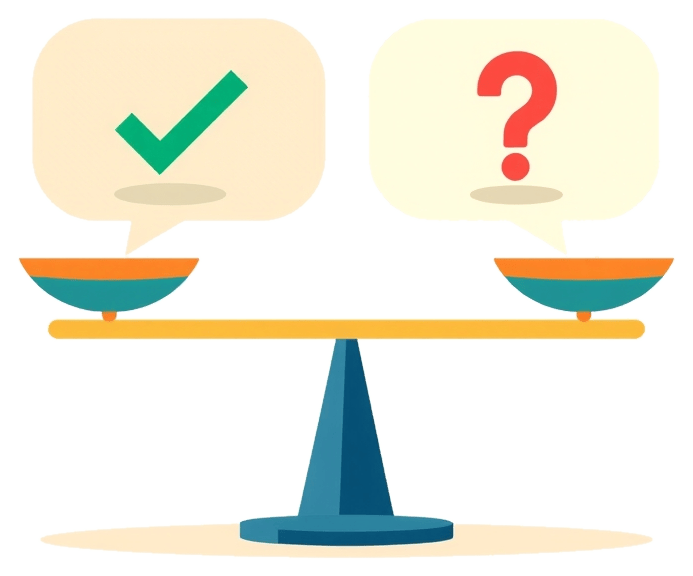
AI sounds exactly as confident when it’s wrong as when it’s right.
A person who isn’t sure usually shows it — they hesitate, they say “I think…”. AI has no such tell. The polish of the answer tells you nothing about its accuracy. Once you truly absorb that, you’re safer than most daily users.
Why does it get things wrong?
Remember how AI works: it learned patterns from enormous amounts of text, and it answers by producing what usually comes next. When it doesn’t know something, it doesn’t fall silent — it produces something that sounds right. The industry calls this a hallucination. It isn’t lying; lying requires knowing the truth. It simply has no built-in sense of the difference between remembering and inventing.
Where it’s usually reliable — and where to be careful
Usually reliable: explaining well-known concepts, rewriting and summarising text you give it, everyday cooking and household questions, grammar and translation, gift ideas, patient step-by-step help with your phone or computer.
Double-check before acting: anything involving your health or medications, money, taxes or the law, recent news, precise facts about people (AI mixes people up more than you’d think), and phone numbers, addresses, opening hours or prices — it will confidently produce outdated or invented ones.
The dividing line is simple: does acting on a wrong answer cost me anything? A dull dinner suggestion costs nothing. A wrong pill interaction does.
Four habits that catch most mistakes
- Ask “how sure are you?” — it won’t always know, but asking often makes it list the parts it is unsure about. Treat those as the bits to check.
- Ask where it comes from. “What is that based on? Can you give sources?” Modern chatbots can often search the internet and show links. Links you can check are worth far more than a fluent paragraph.
- Get a second opinion for anything important — from a search engine, an official website, or a human professional. For health questions, AI is excellent at explaining (“what does blood pressure actually measure?”) and the wrong place for decisions (“should I stop taking this?”).
- Trust your nose. If an answer surprises you — a fact that seems too neat, a quote that fits too perfectly — that feeling is data. Check it.
A five-minute exercise that will teach you a lot
Ask a chatbot about something you know deeply — your trade, your town’s history, a craft you’ve practised for decades. Read carefully. You’ll likely find it’s 90% impressively right and 10% subtly off. That ratio is its character reference. Assume the same ratio on subjects where you can’t spot the 10% — that’s exactly where the habits above earn their keep.
Don’t let this put you off
None of this makes AI useless — it makes it human-shaped in its flaws. You already know how to deal with a brilliant friend who occasionally gets details wrong: you enjoy the brilliance and verify the details. Do the same here, and you’ll get the best of it with very little of the risk. Now for the fun part: ten everyday things AI can genuinely help you with.